In 2025, artificial intelligence changed in an important way. Instead of just guessing what sounds right, AI started to check whether it is actually correct.
Before, AI worked a bit like autocomplete. It looked at lots of examples and predicted what word or answer was most likely next. That worked well for writing stories or poems, but it caused problems in math and science, where one small mistake can ruin everything.
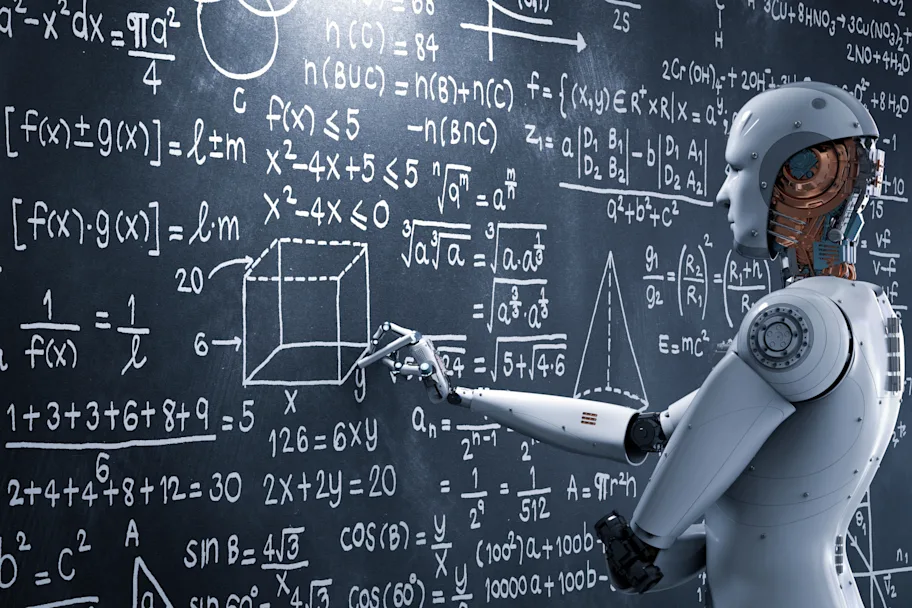
So, researchers changed how AI thinks.
Now, AI often works in steps, more like a careful student solving a math problem:
-
One part breaks big problems into smaller ones
-
Another part translates ideas into math rules
-
Another part checks every step using strict logic tools
-
The AI (sometimes with a human) coordinates all of this
Instead of being rewarded for sounding confident, AI is rewarded only when its answers can be proven correct.
Researchers also taught AI to:
-
Think longer before answering if a problem is hard
-
Check its own work and fix mistakes
-
Learn from problems it already solved correctly
-
Split hard problems into easier pieces
Because of this, AI got very good at math. Some systems performed as well as gold-medal students in math competitions.
This change also matters in the real world. In areas like:
-
computer security
-
airplanes and rockets
-
financial systems
it’s more important to be right than just fast. AI that can prove its answers helps reduce dangerous mistakes.
By the end of 2025, AI wasn’t just copying knowledge anymore. It was:
-
discovering new math ideas
-
proving them step by step
-
and checking itself along the way
2025 marks a turning point where AI moved beyond probabilistic pattern-matching toward formal verification, treating correctness as a hard constraint rather than an emergent property.
This shift fuses neural intuition with symbolic rigor—reviving neurosymbolic reasoning—by tightly integrating large language models with formal systems like theorem provers.
Inference-time scaling became central: models reason longer and more deliberately at test time, with correctness enforced via verifiable rewards rather than human preference alone.
Training advances such as RL with verifiable rewards and critic-free optimization made rigorous reasoning cheaper and more accessible, narrowing the gap between open and proprietary models.
Sparse attention enabled long, efficient reasoning traces, allowing open models to match elite performance on top math and programming competitions.
Data scarcity in formal math was broken through synthetic bootstrapping: models generate, verify, and retrain on their own successful proofs, creating a positive feedback loop.
Agentic architectures replaced monolithic provers, decomposing problems into verifiable subgoals and managing failure through recursion, graph search, and lemma-based workflows.
Verification loops matured—from external theorem provers to internal self-critics—making reasoning both more reliable and more efficient.
Proofs were not only generated but optimized for human readability, ensuring industrial-scale proof remains interpretable.
Parallel theory work showed transformers encode uncertainty and algorithmic structure, explaining why deliberate reasoning emerges with the right constraints.
These advances spilled into industry: AI systems now discover, formalize, and verify new mathematics and algorithms, not just check known results.
A new economy of truth is forming, with platforms and protocols commoditizing verification, attribution, and incentive alignment.
REFERENCES
Victor Shaw. The Industrialization of Certainty 2025 Year in Review for AI in Mathematics and Formal Methods. Dec 31, 2025 https://formalintel.substack.com/p/the-industrialization-of-certainty
Yadav C. Beyond Surface Trust: Towards Incentive-Aware Trustworthy AI (Doctoral dissertation, University of California, San Diego). https://escholarship.org/content/qt92g2w8q3/qt92g2w8q3.pdf https://www.proquest.com/openview/1670da7289a2f95b7e2d12c025fc8c9d/1?pq-origsite=gscholar&cbl=18750&diss=y
Shin D. Automating epistemology: how AI reconfigures truth, authority, and verification. AI & SOCIETY. 2025 Aug 12:1-7. https://link.springer.com/content/pdf/10.1007/s00146-025-02560-y.pdf
Yong Lin, Shange Tang, Bohan Lyu, Jiayun Wu, Hongzhou Lin, Kaiyu Yang, Jia Li, Mengzhou Xia, Danqi Chen, Sanjeev Arora, Chi Jin Goedel-Prover: A Frontier Model for Open-Source Automated Theorem Proving arXiv:2502.07640 [cs.LG] https://doi.org/10.48550/arXiv.2502.07640


